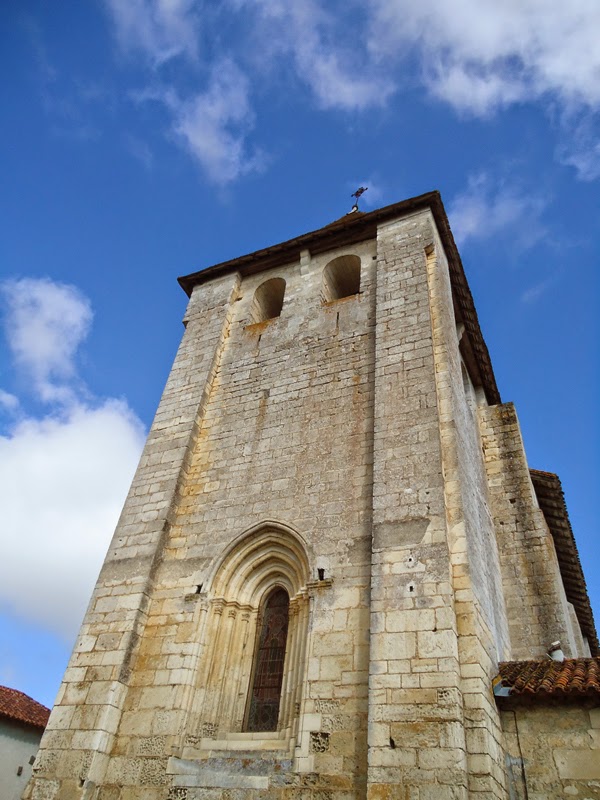
These churches all date from the 11th - 13th century with one jewel box exception. Some of their foundations are probably sitting on foundations of buildings built by the Romans who conquered and settled here among the Gauls in the 1st century.
Monday, June 16, 2014
Romanesque Churches
If you were to join me on my 15-mile bike loop that starts from our house and heads out into rolling farm fields you would be surprised when seemingly out of nowhere a church steeple appears. Come along and I will show you 5 churches to be discovered along this short loop.
These churches all date from the 11th - 13th century with one jewel box exception. Some of their foundations are probably sitting on foundations of buildings built by the Romans who conquered and settled here among the Gauls in the 1st century.
The Perigord region (about the size of Delaware) has always been sparsely populated. And yet by the end of the 12th century there were as many as 400 Romanesque churches in the small region of the Perigord. “Romanesque” because they are based on the principals and style that had been brought to and became a part of the region’s architecture before the downfall of the Roman Empire.
The beauty of these churches comes from their extreme simplicity of design and decoration. A simple, almost severe form, carved out of the golden, light sandstone that is one of the major assets of Perigordian architecture. From the Michelin Green Guide: “The originality of the Perigord Romanesque style is in its vaulting - the dome. Some specialists believe that this shows eastern influence, others that it is a French invention.” The orientation of each church is to face towards the orient, placing them on an east-west axis. The purpose is to have the faithful facing Jerusalem. Or maybe, since the church interiors are as stark as their exteriors, it was to profit from the glorious rays of the morning sun.
During the 11th and 12th century there was a resurgence of population and construction during the brief interludes of peace. During times of turmoil these churches were used for the protection of the population of the hamlets nestled around them. Belfries doubled as watchtowers. Narrow windows allowed light, but not intruders. Some walls were up to 3 meters thick.
Two major periods of turmoil were the 100 Years War between France and England and then the terrible family-splitting Wars of Religion between Catholics and Protestants. Wars washed through and around these small villages and their strong churches. One marvels at the tenacity of the human spirit.
The last small church on the loop is actually a tiny chapel finished in 2012. A privately built and attended chapel. The arrival of this building of faith helps one understand the drive to create a place of spirituality and how such a church community can start out small nestled in it’s hamlet community of about 14 houses and 12 souls.
Thursday, June 5, 2014
Monday, June 2, 2014
A Sunday Drive
We thought we were heading out for a leisurely Sunday drive. Yesterday around 2,300 public and private gardens were open across France. Our plan was to mosey along and visit 4 or 5 of them within an hour of home. The loop I chose took us into the neighboring Charente Department. We had not explored here yet so all was going to be new and exciting. And exciting it was!
(Again this week I hope you are pleasantly exhausted at the end of the photos. I try so hard to keep my post tight, but...)
Not even on the list of visits we tumbled upon this monster abandoned chateau, La Mercerie.
Next stop was an amazing garden created by a lovely couple. Even Tom said he was exhausted by their attention to detail. Yet he has plans to return this week to paint. The compositions were wonderful. Jardin de Christaline
Then we tumbled down into a hidden valley with strong flowing springs. The family has owned this property since 1643. The current owners great-grandfather still ran the flour mill. The mill was turned into a summer home in the 1920's and I wish I could show you the unchanged art deco interior. Moulin de Nanteuillet
We took time to recharge with a warm crepe and rose jelly. The owner of the mill came over to make sure we found it delicious and refined.
Now we climbed up to a perch overlooking golden farm fields. It was becoming obvious that these old gardens had one thing in common, water. All of the properties had several springs and enough water for the farm, home and then extra for the luxury of a garden. This private family home has fallen into the "a gentle plea for chaos" category. Jardins du logis de Chenard
The next gardens were nestled around the ruins of a 12th - 18th century Cistercian Abbey. Springs and a underground water system are the strength of this long inhabited valley. The grounds and the monks living quarters have been lovingly restored. Jardin de l'abbaye de Fontaine Vive
Finally -here is our last stop. Aptly named Jardin du Pere et de la Mere Cucu. "The garden of dad and mom a little bit crazy." And so it charmingly was!
I leave you with the Queen of the Compost. Happy gardening!
Subscribe to:
Posts (Atom)