Sunday, February 14, 2021

Rivers Up 2021

As it straddles the Dronne river, the charm of the village of Bourdeilles comes from how houses, gardens, and empty fields are arranged on the river’s left and right banks. On the left bank is the town center, the Bourg. The right bank is host to the “not-quite town center”, the Faubourg. 

Houses in the Bourg rise upward along the road leading up to the castle. A castle that is defensively perched on a rocky outcropping. It is literally overhanging the river. 


Houses in the Faubourg are regimentally lined up along the edge of empty fields that follow the river. These fields are left open because they are on the floodplain. This neighborhood is at the mercy of the river.

Most of the year the picturesque Dronne flows gently along, animating her artistic setting with sparkling ripples and visiting wildlife. The folks of the Bourg and the Faubourg mingle as they cross paths on the medieval bridge connecting the two neighborhoods. One can’t cross the bridge without stopping to count the trout lingering in pools formed behind the bridge’s five stone arches. Everyone’s hands move in or out to show how big this fish or that is. The babble of the Dronne is contagious, echoing into human voices. There are tales told out there on the bridge.  


Those animated neighborly visits above the river are for spring, summer, and fall.  Early winter shortens our chit chat to a quick,“how ya doing?”.  The trout are harder to spot and grey skies don’t encourage visiting.  Only the juiciest bits of gossip are worth a few extra moments discreetly shared over the murmurings of the river. Then the rains start. After the long hot summer months of pounding sun and parched sunflowers, the first few weeks of grey skies and wet pavement are welcomed.


January days alternate between heavy rain or gloomy drizzle. There are no days of drying sunshine.  Little lakes start to appear in the fields along the river. Everywhere, high and low, the ground is saturated. The ducks and the herons gobble up rising worms and drowning moles in the disappearing hay fields. We start to pay attention as the sweet, easy going Dronne creeps up her banks. Gone are the sparkly ripples. The swelling river’s surface has smoothed out, she’s changed color, and she’s moving fast. Newbies to the area start to twitter about how high the river is. Oldies aren’t worried —yet— but they make a mental note of the river’s level each time they pass by - good to keep an eye on the ole gal. 


Instead of every conversation starting with “fine day” you hear “rivers up”.


Bourdeilles organized itself for this annual phenomenon years ago. The Bourg was established here long, long ago because of the high ground atop the cliffs on the left bank. The low lying neighborhood of the Faubourg had to be precisely calculated. Clearly people have always payed attention to the tipping point of the episodic floods. Everyone knows that even a modest change in the amount of water pushing down stream will send the waters seeping into and then sweeping across the floodplain. You can pretty much tell where the water is going to max out in a typical flood by where the line of houses starts. However even with this careful placement there is always the risk that some floods might exceed planning. For the inevitable flooding the ground floor of these homes was reserved for livestock, farm equipment, things that can be easily moved (remember some of the houses date to the 1600’s). Living space starts on the first floor (which, to Americans, is the second floor.)


February arrives and the rains keep coming. Two, three, four days and nights of nonstop heavy rain. There is too much water to rush along towards the ocean outlets. The river pushes off the rocky bank seeking the easiest release.  Water sweeps over the fields. The expanse of water looks languorous and glassy. It also looks menacing.

There’s a buzz on the bridge as folks come out to watch the waters sliding across the fields and creeping up the inclines in the alleyways. There are only a few places that might get flooded, but everyone is watching them with excitement and apprehension.


In 2003 I went to the bank in Brantome to pay for one of those Faubourg houses that a big flood will flood. On my way to the bank appointment I had to stop at the farmer’s co-op to buy Wellington boots, I had to pass swans swimming in the parking lot as I sloshed through water coming just centimeters from the tops of the wellies as I bobbed up and down on springy, quickly laid planks. The actual sidewalk was nowhere to be seen under the flood water. During the closing transaction I had to draw a picture showing the location of our future house (I was learning a lot of new vocabulary that day..) “Is that in a flood zone?” A question whose answer would surely affect our homeowners insurance. What to say? I’d just seen the river lapping at the threshold. “Yes”


Forty or fifty years ago a damn was built so humans could “control” the flow of the Drone. The arrival of the damn put an end to the annual threat and excitement of high waters. Nowadays it seems to be about every ten winters that the reservoir gets more water than it can handle. That’s when the folks controlling the dam contact the town hall, sending out a flood warning. That warning call is when we can’t deny how precarious our situation is. Some people have vertical runners on each side of their front doors.  When the call comes, wood planks are put here to try to keep out the flood.  All of the houses have ground floors made of concrete, tile, or paving stones. Water coming in is no big deal.


Mid-February and the rains have slowed and the dam has closed it’s gates (gotta keep as much water in the reservoir as possible for next year’s inevitable drought). The high water level receded quickly.


Crossing over the bridge, our lengthening conversations are about next week’s forecast for sunshine and warmer temperatures. The River Dronne is nestled back in her banks. Her winter animations are over. We can relax and enjoy the charm of it all— the trout in their pools, the swallows sweeping over head, and the Dronne’s sparkling ripples of spring, summer and fall.


Saturday, January 30, 2021

Magic in the Village


The winter days are grey and foggy in Bourdeilles, but look closely and you’ll see a little sparkle in the main street.  A young lady has dared to open up a shop in the practically abandoned center of the village. Her name is Pauline. Her’s is a gutsy adventure, but this is exactly the sort of madness that a small village in France needs.


If you don’t live in Bourdeilles and you drive through too quickly you’ll think that it’s a ghost town, but if you slow down and turn your head at just the right moment you will notice some happy lights twinkling in a window between gloomily closed shutters. You’ve spotted Bourdeilles’ newest spark of life. A little grocery with so much more to offer than you would imagine - L’épicerie Abracada’vrac— ‘the magic little grocery store for buying in bulk’. I just call it the magic shop.


Pauline is the third generation on her father’s side to live in Bourdeilles - the eighth generation on her mother’s side. She didn’t grow up here, but spending all those summers and school vacations with her grandparents gave her a taste of village life. After a few years working in the city she and her partner made the decision to slow down life and to start a family smack dab under one of the tallest castle towers in France. Pauline’s dream has been to open up a little grocery. The couple worked out that they could create a shop in the basement of their home under the castle. Like shop keepers of days gone by the family lives upstairs and the commerce is downstairs (if you look carefully you’ll spot the baby monitor on the checkout counter next to the register..). This all encompassing way of life has been disappearing, but lately there is a small revival as some young people are trading the hustle of city life for a quieter one in the country.

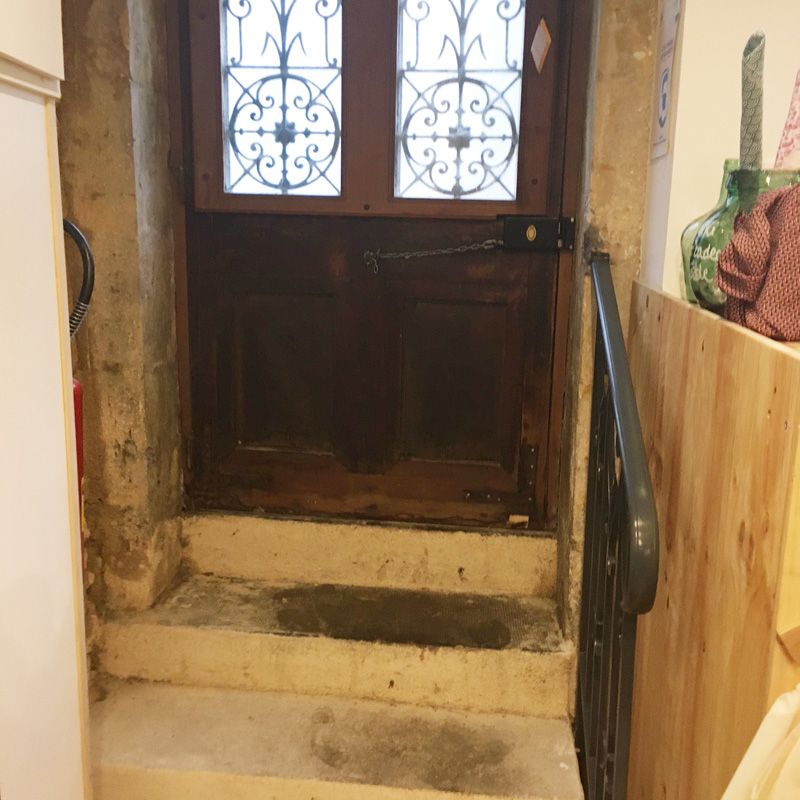
It’s a bit of an adventure to shop at Abracada’vrac. There is no parking lot at the entrance. You either have to park your car by the river and wander up, or below the church and wander down. Walking from my house, I pass under the castle tower and through a multi-centuries canyon of houses, equipped with empty shopping containers. Shopping here is BYOC (bring your own container). The shop entrance opens abruptly onto the street. The door handle is decidedly 1940’s French and I have to mind the couple of steps down into the warm and welcoming shop. Pauline greets me with a wide smile that sparkles with enthusiasm. You can’t help but be caught up in her pride for what she has created.  A pride that is shared by the community. She courageously sent out a request for seed money. Where times are always a little tough the concept of crowd-funding isn’t something you find in a small village in France. It ain’t easy to ask, but ask she did. She is encouraged by the enthusiastic response of the folks of Bourdeilles. She in turn invested in the community by hiring a local furniture maker to help plan and build the custom shelving for the awkward, cramped space. They have quite successfully created an atmosphere of simple elegance.


Here’s what I’ve spied in the magic shop so far— black licorice, spicy crackers, several choices of pastas, beans, flours and rice. I’m currently obsessed with a rice that comes from the Camargue region of France. There are olive oils from Provence and walnut oil from our region of Aquitaine. There is a section of cleaning products from detergents to toothpaste. There are household and baby care items that are practical and pretty at the same time. These make great little gifts.


It’s going to take me awhile to organize the correct containers for shopping and storing what I buy at the magic store. I’m enjoying having a practical use for my milk bottle caddy and all the apple juice bottles I’ve been saving. I might have to spring for some more mason jars with wider openings for filling. My goal is that our pantry will look more like a calm photo in a country living magazine than the spoils from a rampage in a dollar store.


Pauline has done the hard part for us. She screwed up the courage to launch herself into risks and long hours of work in order to concretely do something about her conviction that the long term global cost of our shopping habits is not acceptable. Wrapped up in this conviction is also the desire to help animate our little village. Now it’s up to us oldies to grab a basket and some jars and enjoy the magic and sparkly light offered by this little épicerie in our small village in France.

--join her on FaceBook  Abracada'Vrac-Épicerir Vrac Bourdeilles  

or 

www.AbracadaVracBourdeilles.com


--a couple of other "frenchie" food sites I'm enjoying on instagram  

- katedecamont

-dancing.tomatoes

Saturday, January 16, 2021

The Man who wanted to be King of America

I’m constantly tearing out articles that catch my interest from our local newspaper The SudOuest. This a quiet region so the paper uses a lot of non-news stories as filler.I love it when the filler piece is both local and historical. Especially anything to do with a French/American connection. A good pandemic exercise is to make a big pile of all my newspaper clippings and see what jumps out at me. Here’s a good one.


“The Man who wanted to be King of America”

I’m terrible about keeping the date attached to the clipping, but I do know that this is not an April Fool’s article. This is a factual accounting of a Frenchman that thought it would suit him to be king of the budding United States of America. Here’s how the story goes.


Once upon a time, a long time ago, Charles-Francois, count de Broglie, was born in Paris. The year was 1719 and his prestigious father was head of the army of King Louis XV.  Needless to say, the well-connected boy rose quickly in the ranks, eventually becoming a general, the ambassador to Poland, and a secret agent in the service of the King. At age forty de Broglie used the dowery of his new wife, the Princess Louise de Montmorency, to purchase the county of Ruffec. (Which is in our corner of France.) This deal came with a county, a nice village, and most importantly, a title.  De Broglie was now the Marquis de Ruffec.


While de Broglie was amassing his titles and fortunes the far-flung American Colonies were organizing to break away from England and the rule of monarchy. As the English were the sworn enemies of the French, the Marquis de Broglie decided that now was a good time to encourage the king to involve France in this insurrection. He is quoted as writing,”The American colonies are destined to one day form an independent state. Sooner or later it is destined to happen.” His purpose was to help move things along.

Apparently he already had visions of grandeur of what he hoped to gain from this foreign conflict. He wrote a letter of self-promotion to the Baron Jean deKalb, a German born French general. DeKalb had already joined the Continental Army and had strong connections to Washington, Adams, Franklin and the Marquis de Lafayette. De Broglie wrote, “America needs a political and military leader that can impose and reunite. Someone who is capable of attracting and leading with him a considerable number of the population. You have the power to make known who you think can fulfill this position.” De Broglie’s description of who he thought would fit the bill strongly resembled himself. His pretensions and his narcism were over the top. Earlier in his life he had tried and failed to become Prime Minister of France, he had bought the title of Marquis, so why not try to be a King?


While waiting to see how his political aspirations were being received in the court of King Louis XVI de Broglie jumped into non-stop work. Between his properties in the Charente and his commitments in Paris, he worked day and night. He organized his memoirs, he schemed and presented recommendation and plans for France’s participation in the colonial revolution. He directed mines, constructed a forge for cannons and drained the swamps around his county. He kept up very good relations with all of the military suppliers of La Rochelle and Rochefort, the centers of naval power in France. These resources would come in handy when it came time to launch his ambitions in the Americas.


In May of 1776 de Broglie was part of a small group that secretly sent Versailles a plan of action for France’s involvement in the American conflict. At this point de Broglie still felt it was too early for France to send over troops. He wanted to wait until the American Congress requested France’s aid in ships, armaments, and soldiers.  All to be led, of course, by de Broglie. July 4, 1776, and the Declaration of Independence, moved his plans forward.


 In December of 1776 de Broglie gave instructions to deKalb to lead the way for his ascension towards ruling America. DeKalb was to “suggest” the idea of de Broglie being appointed king without outrightly stating that this was was the final intention. He had even schemed up a royal procession to traverse his future kingdom. By now deKalb was distancing himself from the project, declaring de Broglie’s ideas more than a little crazy - “une folie” (a foolishness or maybe a folly).


All of this scheming and de Broglie had never even left France!  Benjamin Franklin, now the chief diplomat in Versailles, shot down de Broglie’s petition to be sent to America to “represent” France. This opposition  was the end of Charles-Francois de Broglie’s dream of becoming King of America.


Undeterred in his efforts to help the American colonies de Broglie put his energies into financing a voyage for the young Marquis de Lafayette. Lafayette sailed from Bordeaux on La Victoire in March of 1777. Lafayette was to play a critical role in America’s road to independence.


De Broglie died alone in August of 1781 near his village of Ruffec. The newspaper article makes a point that neither his wife nor his children were at his funeral.


from - SudOuest, LeMag   written by Jean-Michel Selva

Friday, December 18, 2020

An Unlikely Warrior - Wild Boar in the Hood

--today we have a guest author and illustrator - Tom Vieth


Susan wrote a blog about getting lost in the woods.

I finally figured out why it is so easy to get lost in our local forest. It has to do with animal tracks and thorn bushes.  The forest is chock-a-bloc full of quadrupeds. There are  two species of deer— small ones with little prong horns and big ones that, oddly, bark with a sound like a dog with a bone stuck in his throat.  The forest is home to foxes, weasels, and badgers.  But there is an undisputed king of this jungle:  the sanglier, the wild boar.


Sanglier are all muscle. They weigh the same as a St. Bernard, but are much more dense. To eat wild boar meat you have to cook it for TWO DAYS.

These animals have created a vast network of well-worn paths.  Many of the paths seem like an  inviting, believable human trail. Go ahead, you tell yourself, it's a fine path. Until you hit a patch of thorn bush. Welcome to the gates of hell.


The thorn bushes aren’t really shrubs. They are wild blackberry vines, brandishing uncountable three meter-long branches that create, for humans, a horrifying mass of pain and suffering.


Once a vine has you,  you turn.  Turning causes the vine to spool you into other vines  The more you struggle the more deadly becomes the embrace. You are hit by a tsunami of panic that obliterates reason and any sense of direction.  You will do anything, move in any direction, to get untangled. Finally you are free!  And now, completely disoriented, you are lost.


An Unlikely Warrior

Every December the usual pattern of cold and rainy, rainy and cold is broken by a couple of days of improbable sunshine and mild temperatures. On the train route to Blahsville,  someone put in a hidden magical stop.


Susan, our neighbor, Marte, our deaf Cavalier King Charles, Daisy, and our ridiculously cute Cavalier/Chihuahua, Little Bit, had just entered the forest for a Sunday afternoon walk.  The dogs were off-leash. Susan was wearing an orange vest because hunters hunt on Sunday. 


The wooded valley we were in is deep and steep.  The path is cut into the sidewall, with a bunch of space going down through the brambles and trees below us and another rise of brambles and trees towering above us. We were moving along the path, fragments of  conversation tossed out to the rhythm of our footsteps. 


Suddenly we heard Little Bit cry out.  She was across the narrow valley.  The call she let out was not from a cute little half-breed.  It was a chilling siren wail.  Something was wrong.  We stopped to listen.  Gradually we heard the sound of twigs crackling and wood snapping.  It is the same sound you hear from a bonfire, louder than you would expect, it is an angry noise from an amassing of thousands of bits of destruction.  But there was no smoke. Then we saw the beasts.  Susan yelled, “Get behind a tree!” Four sanglier were pushing through the brambles below us. We know that in a disaster time seems to slow down. It seemed we were experiencing that when the snorting, thrashing beasts were coming upon us.  In fact it was like a movie in slow motion.  Parallel to our path, the panicked sanglier were off the track and running straight through the brambles.  The wild boars, a total of 800 pounds of brute strength, were surging through the thick mass of thorns like they were pushing against a wall of flood-borne debris.


Just as they got even with us, the wild boars turned to cross our path, searching for escape on the slope above. Three sanglier cut between us and Marte.  Marte was perhaps three meters from us.  From where we stood the beasts were nearly close enough to be in the pee-in-your-pants zone. As the last beast blasted by we saw what had spooked the wild boars. Yapping hysterically, Little Bit was on their heals and heading after them up the side of our valley! All I could think about were the scars I’ve seen on dogs that hunt sanglier.  And those were all big dogs without a trace of Chihuahua in their bloodlines.


Hoping to stop this madness, we were screaming and blowing the whistle.  Our cries were joined by the barking of a pack of hunt dogs. Over this was the noise of the hunters’ horns trying to call back their dogs. I headed up the slope after Little Bit.  A large deer bounded past me heading down hill.  I could hear the cacophony of barking dogs, indiscernible French from Susan and the equally indiscernible French of the hunters speaking in the local dialect. But no Little Bit.

A very crazy Daisy trying to launch herself after the sanglier.

This isn’t a movie, so the drama passed and everything eventually got straightened out.  The hunters gathered their dogs and moved on.  Marte and Susan were wearing down the adrenaline jolt by talking through what had just happened. From a direction in which I was not heading Little Bit returned, safe but completely bonkers with the excitement of her chase. 


As we settled down we began to think about how long it took the wild boars to push their way through the brambles.  It was long enough for me to catch Daisy, leash her and yank her out of harms way. It was Long enough for Susan to shout get behind a tree several times in English and then, remembering Marte, several times in French.  As it turns out it was not quite long enough for Marte to find a living tree.  The tree she first went to wouldn’t stop a sanglier because this tree was dead.

In the bear populated American West, forest rangers tell you that the best way to survive a charging bear is curl into a ball and take the first swipe.  If, through the ensuing great pain you can play dead, the bear might move on.  I asked Susan if her poise in shouting out “Get behind a tree!”  was what she had been told is the standard wild boar version of “Curl and take one!”  She said no, in the moment of chaos, it just came to her.  She’d be good in tornados, too.


We turned around and finished our walk by passing through the village and up along the ridge that runs through thousands of acres of wide open, sanglier-free farmland.


Last week I listed a few Blogs I go to to escape or to dream - how could I forget Corey Amaro's adventures into the brocante world and her beautiful, dreamy images of France. French la Vie


and here is our WARRIOR at peace


Saturday, December 12, 2020

Garden Misfits

What are two obsessed Sunday Morning Antique Fair shoppers supposed to do when they run out of room for any other thing? Every nook and cranny of the house is filled and all the spaces in the garden with more than 2 inches of soil are fully planted. Our obsessive “antique” shopping is funny because we never go shopping together for anything else. If the antiques would just stay in the antique shops we’d be fine. But no, we are lured out to the antique fairs rain or shine, cold or heat, lured to see what treasure might reveal itself and loosen our purse strings. You could tell us it would be more sensible to stay home, to show some restraint, but that is prudent advice. Being prudent is a rational thing. Craziness is irrational. We know full well that we’ll see all the sad bits and bobs that the antique dealers have been lugging in and out of their sad vans for months, possibly years. Before any junk arrives here in the hinterlands, the cream of the crop has been skimmed off, the better bits sold off, and we will be shopping through the dregs.

But there could be wonders hidden in the dregs! It’s easy to nose out treasures when you are the kind of people that every year buy the scraggly Charlie Brown Christmas tree that no one else seems to want.


Because our house is crammed full and the flower beds are overflowing we have narrowed our treasure hunting down to stuff that can be used in some way or another outside. Most of the stuff wasn’t intended to be placed in a garden.  All of it seems to be very heavy: a seven-foot long carved stone lintel from 1704, two 12-foot oak doors with cast iron grills, cast iron fire place backs, zinc trim from the 1800’s, two iron windows with stained glass.   Even the things meant for the garden are heavy:  cast-stone pots, carved stone well-heads (think precursor to the cute wooden wishing wells for lawn decoration.) 


Once we have spotted our object of desire the trick is to stand there in the middle of the junky, bustling antiques fair and try to conjure up some creative way to incorporate the thing into the garden landscape. Our imaginations have to slide around the treasure’s original purpose. Surely there is a way to give new joy to this misfit. (Our treasures are always a little dented, chipped, or weary from the years.) Most of the time one of us can cook up some fanciful proposal. Sometimes we just say what the heck, we’ll figure it out once we get the dang thing home.


The whole time we are cooking up our idea we have to be sure not to look too interested or too enthusiastic in front of the seller. Our next step is to ask the price. We hold our breath. We either let out a gasp and walk on, or we look sideways at each other and convey the signal “yes”, or “let’s haggle”, or “let’s think about it”. 


How are we able to afford these treasures for our ‘garden of divergent purposing’? Here are three examples of how flea market misfits came to our gardens:


At one Sunday morning antique fair we spotted two stained glass windows We thought they were magnificent. Our imaginations started feeling around for just where in the garden these two crazy things could be put to use. They were regal windows, but not too fancy to be abused in a creative sort of way. To our surprise the price was right. The young man selling them was sick and tired of cautiously loading them in and out of his truck. Tired of living with the anxiety of shattering them every time he hauled them to another antiques fair where people just walked by saying “oh those are beautiful, but I don’t live in a chateau. Mighty drafty. Mighty heavy. Mighty shabby.” The deal was made, we went home to get the trailer, the young man joyously helped cradle the windows into the trailer, and then we anxiously and cautiously drove very slowly home.

There are the three concrete captains chairs we lugged home form Bordeaux. Actually we had to make a second trip for those because we had deliberately left the trailer at home in order to restrain our imaginations to only things that would fit in the back of our car, but… (what did I say about prudence?) Who could have imagined that we’d find things so big, so heavy, so ugly, and that we just had to add to our oddball garden decor? We asked the price. We held our breath. The vendor was from some place hours away and really did not want to return home with all that weight. It was the first day of a two-week fair and he figured a bird in hand was better than wondering if any other suckers would come along. He gave us a great deal on the condition that we were responsible for getting them out of there. He would lift them -one more time -into someone else's trailer, but that was it. Good riddance and drive carefully.

Another Sunday we walked up to the antique fair right here in Bourdeilles. The mile walk home would keep us from buying anything. We were ambling among the sad stuff when suddenly Tom said, “that was interesting.” “Hmm” I said, “did you see that weathervane?” That was it - the object of our desire. It’s a weather vane, the indicator doesn’t turn, there is no N for north and the E is missing it’s bottom half. There are blobs of metal here and there where someone has tried to hold everything together with poorly done welding. We ask the price. “What you see is what you get and you have to get it out of here.” You could see the astonishment on the sellers face when we did not haggle with his reasonable asking price. Tom grabbed the top half, I grabbed the bottom half, and off we carefully paraded down the main street and over the river to see where this zinc weather vane version of a Charlie Brown Christmas tree would fit into the garden landscape.

There are oh so many more objects of desire sprinkled in the corners of the not yet filled up yard, but you’ll just have to come visit to see them. It’s an obsessive garden but not a secret garden.


Finally one that was too big even for the trailer - there were two of them. Imagine them in a small village in france. Tom was tempted.

Follow our adventures on Instagram- artsy.french.life

Since we are still on strict travel restrictions, and no Sunday Antique Fairs, here are some places I go for a vicarious adventure:

Southern Fried French "So, we've been doing a lot of walking around Beaune, and one of my favorite pastimes is to take a closer look at all the architectural details of this charming historic city. And what has caught my eye this week is another sort of confinement tool: the garde corps. 

My French Country Home "When it comes to a recipe repertoire, it’s very easy to fall into a rut, using the same recipes over and over because we know they work.   Which is why I am always on the look out for new ideas.     In our magazine My French Country Home, we always include recipes for French dishes.  And in the current issue we turned to cookbook writer Kate Hill.  Kate lives in South West France, in a beautiful country home.   As well as writing her books, she also offers cooking courses, and now I’ve tried out her recipes, I’m thinking I should go!"


The Good Life France It’s a little gloomy here in France to be honest but you probably all know this already so I won’t dwell on that but on the joyful things I find in life. Like Bread Man."