Friday, March 27, 2020

Home in a Bowl of Granola

Normally baking a batch of granola makes me think of home. This week thinking of home made me bake a batch of granola. 
You ask how can granola have anything to do with “home”? 

Where do you call home anyway?

For me I have two homes. Home is here in France now. Home is back in the States then. Mentally there is room for both.

The other day when it became apparent that we had to cancel our trip to visit with family in Virginia and Florida I consoled myself by baking granola. This simple activity filled my brain with wonderful memories, emotions, and experiences. For a few minutes in the kitchen I was joined by friends, family, and old familiar places.

Our dear sweet friend Anne Marie introduced us to this magical granola recipe. She would cook up a big batch, divvy it into small mason jars, and pass it out to anyone she visited. She visits with lots of people. Your eyes light up when you see that chunky mixture full of oats, nuts, fruits, butter and maple syrup - all adding up to a bowl of love.
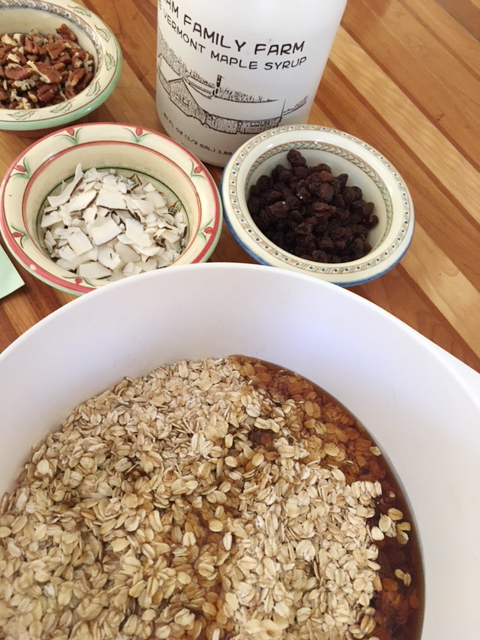
Turns out there were quite a few of us being honored with these precious visits and gifts from the warmth of Anne Marie’s kitchen. Perhaps motivated by exhaustion, at some point she wrote out the recipe and told us we should give it a try ourselves. The steps looked daunting and it turns out a few of us were reluctant to risk the fear of failure. We requested a granola cooking lesson which was happily granted. In Anne Marie’s sun-filled kitchen we mixed up and baked granola, laughing about how easy it actually is, and wondering what had we been afraid of. The only hidden ingredient that each of us would have to add was our individual version of a great big dash of love.

As I mix and chop, it’s comforting to relive the warmth and love that Anne Marie concocted and shared with her community. I picture myself with the extended family that weaves out from that happy kitchen. I now share granola concocted in my kitchen with our ever-extending family here in Bourdeilles.

But wait, there’s even more magic to the magical granola recipe.

Home having been Vermont for 25 years I can’t help but have been influenced by Ben and Jerry’s.Their over the top need for great big chunky ingredients, the best quality flavors one can rustle up, and big scoops of consciousness. My granola is chocked full of stuff: golden sultana raisins, Perigord walnut halves (yes halves - not chopped), dried cherries (when I can find them, they hardly exist in France), sliced coconut, and goodness knows what else. Ben and Jerry’s has two easy-to-remember mantras: if it’s not fun, why do it ? and practice random acts of kindness - just do whatever you can to help the world in whatever way you can - and do it humbly.

Here’s a confession of my extra extravagant special ingredient in this magical granola recipe. It’s Isham Family Farm maple syrup. We ship it back no matter the cost. Mike Isham has even totally spoiled us and shipped us more - stop that Mike!!  (Another lovely friend has done the same, but she will remain anonymous - well because she is a lovely quiet person.)  We are spoiled!

Maple syrup makes me think of hard work, nature’s bounty, family commitment, and shared community. It makes me think of the sugar maple trees we could see from our home in Vermont, the tubing (no longer buckets) running through the forest for the sap to flow, the gurgle and gush of sap flowing into the sugar shack, the steam rising into the night sky as several generations of sugar makers work side by side to boil down the liquid gold. Hours and hours of boiling. Stacks and stacks of wood for the boilers. I appreciate the finesse of knowing how to work with nature to bring to perfection one of her gracious offerings. Vermont is full of such families. The Cotys and the Wells are two more that I have close ties with and I picture them working in the sugar shack with the steam roiling around, very little sleep until the warmth of spring arrives in full force, and everyone pitching in in whatever little way they can.

For me syrup is not just Vermont. Some of my earliest memories of traveling as a family were drives up to the highlands of Virginia. I’d stare out the car window waiting to spy lambs jumping around on the green grassy fields. I loved those lambs! I loved stopping the car to see if we could entice the bleating babies to come closer to the fence. It’s all hazy, but I seem to recall my Grandfather teaching me to stand quietly and patiently near the fence to watch. I know my parents took us up to the Highlands to partake in the annual sugar festival. Everyone high on too much sugar and camaraderie.

There you have it-  the rush of memories that mixing up a batch of granola has for me. Now here in my small village in France it is my turn to introduce the magic of the magical granola recipe.

P.S.
Thank you Aunt Marj for all the Aunt Marj Cookies and the memories from the Iowa side of our homes.

P.P.S
Kathy please tell Aunt Marj this. She is the only person less technologically connected than Tom….

How could I forget the recipe......
preheat oven to 350 F
my oven here is weird so I have had to play with timing and when I put in ingredients (I cook by the brail method...and have modified a lot of steps from the original Magic Granola)
I also like this on the crispy side so I keep an eye on it and pull out as it is browning

First time in the oven: 15 minutes
melt butter and honey together 
mix the following ingredients together
  • 4 cups oats
  • 1/2 c oil  usually sunflower or some such I'm not picky here
  • 1/2 cup syrup
  • 3 tblsp butter I use salted
  • 2 tblsp honey I use local!
  • 1/3 cup coconut

spread out on a cookie sheet - or two 
place on middle to lower racks in the oven

Second time in the oven: 15 minutes
take out of oven and mix, especially around edges
  • 1/2 nuts I use either walnuts or pecans 
  • 4-5 tblsp ground flax

Take out of oven
stir and be sure to get off the edges
Let cool and add - and anything else that floats your boat
  • 1 cup golden raisins
  • 1/2 cup dried cherries
  • brewers yeast


Sunday, February 9, 2020

The Truffle That Almost Got Away

The Sunday morning cafe conversation was moving fast. By the time I arrived the gang was already in the middle of a heated conversation about the upcoming mayoral elections. When a politico interloper joined us the conversation abruptly switched to the French Women’s National Water-polo team and if they had any chance of making it into the upcoming summer olympics (the daughter of a local is captain of the team). Next thing I knew we were talking about a day out with one of the local hunting groups. Laughing over unloaded guns, missed shots and lost dogs, led to a question. 

“Where was the group hunting?”

“Hmmm good question. I’m not exactly sure. Across the river, up the hill. We kept crossing through truffle farms.”

“Sure hope you didn’t tramp around in my patch!”

—With that the conversation veered again. I’ll tell you a story I heard of another kind of hunting. The names , images, and locations are changed to protect The Precious Secrets of the Truffle Hunt. Be forewarned that truffle stories are like the fish that got away stories, they take on a life of their own and get more and more grandiose with each telling. I have in no way embellished my telling of this tale — who knows about the teller…..

I’ll preface this story with a little background. Truffles are not something you talk about in public. You don’t tell where you are collecting truffles, how many you have or have not found, and, if there are extras, whether or not you have sold them. To look at these ugly black blobs (tuber melanosporum, French Perigord Truffle, Black Diamonds) you would never suspect that there are some substantial sums (1000 euros per kilo) being earned by intensely discrete truffle hunters. Truffle cultivation is more like hunting than farming because the “farmer” is at the mercy of the gods, there are no proven farming skills or miracle fertilizers that are going to make gathering truffles anything but a passion of patience and luck. This is a hunt for a stinky black thing that grows in crappy soil and is either discovered and uncovered by a rooting pig, hovering black gnats, or a snuffling dog.
A snuffling dog was the highlight of this Sunday cafe tale……… 

Pierre was checking on his truffle farm somewhere between Bourdeilles and the Back Forty. The “farm” is really a grove of trees inoculated with a fungus that may lead to the production of truffles. He didn’t have high hopes for finding anything since the weather had been so uncooperative during the growing season of the region’s most famous delicacy. Too wet in the spring, too dry in the summer, and too warm this winter.. However, as he entered his truffle farm he was pleasantly surprised to see a swarm of tiny black gnats hovering just above a bare patch of earth under one of his carefully tended truffle oaks. Ahhh today was going to be the day he struck gold, black gold! Delicately he raked the cultivator directly under the swarm scattering the gnats higgledy-piggledy. Pierre scratched out a patch about a foot across and 1 to 2 inches deep, then three feet across and 3 to 5 inches deep, then five feet across. Nothing! 

“Stupid gnats! Fooled again by that ole wive’s tale.”  

As he was loading up his tools into the back of his battered white van a snazzy, dark green car pulled up, windows rolled down, accordion music blaring, a small yapping dog perched on the drivers lap.

“Spoiled rotten dog,” came out before Pierre could clap his trap. 

“And hello to you, too,” said the driver. 

The car door opened and a white squirming ball leaped out yap yap yapping around Pierre’s feet. 
The driver crawled out of the low slung door. “That frown of yours doesn’t bode well for your having found any treasure out there.” 

“Heck, I’ve dug half way to China and haven’t found a thing.” 

“Princess doesn’t seem to think you were looking in the right place.” 

Sure enough the yapping had stopped and Princess was circling around the barren circle Pierre had just scratched out. Nose to the ground, tail wagging high, the little white dog inched her way around the perimeter of the hole. Within less than a minute she stopped, back end up, tail stiff, front paws throwing up tiny climbs of dirt. Her expert nose had led her easily to her prey. That prey was a mere 3 inches to the side of Pierre’s enormous hole. 

“Gently, gently,” Pierre and his friend both said at the same time. 

There was no need for that warning. Uncovering truffles is old hat for Princess. Forty seconds later the little dog looked up for praise. Between her tiny, sort of white paws, was the tip top of a black ball - a pingpong ball sized truffle. 

“Oh hell,” Pierre sighed. 

“She’s good isn’t she?” cooed the friend as she turned on her heels whistling for Princess to follow.

Watching the luxurious Jaguar scamper down the country lane Pierre thought out loud - “Reckon it’s that dang little white puffball varmint and it’s truffle nose that bought that hot rod for Veronique.”
Now sitting with our gang at the cafe Pierre wrapped up the story by making sure we knew that so far this year he has only found enough truffles for family consumption. He has no extras to sell - either at the market or over a friendly cup of coffee - at least that what he told us last Sunday at the cafe.

Here some facts about truffle dogs that were shared at the cafe:

  • any dog can be trained to hunt truffles
  • smaller dogs are often better because they are less likely to damage or gobble up the truffle 
  • truffle oil is massaged onto a nursing dog’s teats so the puppies learn the smell
  • training starts with hiding items smeared with truffle oil then moves onto broken bits of truffle hidden in a known location
  • small dogs are easier to push away from an unearthed truffle than are 300 lb. pigs

Sunday, February 2, 2020

L'art de vivre

Quite a few years back I was given a Christmas gift. Like a child I tested the weight of the neatly wrapped package, guessing what it was. I didn’t know it yet, but this was one of my best ever gifts. The wrapping paper torn, the cover revealing itself, it was obvious that I was going to like this book.

The gift giver watched as I opened the treasure. She explained how it had been hard to pass on this mail-order, used copy book, signed by the author (inscribed to a Monsieur Roland in 1996).
The title and cover photograph were already enough to tell that I held a world of ‘frenchiness’ in my hands. The title flows sing song to the rhythm and elegance of french, the syllables stringing out to a soft conclusion. 

L’art de vivre au fil des jours       

The Art of Living to the Rhythm of the Days  — or —- The Art of Everyday Living

by  Victoire de Montesquiou 

—what a name! In her elegant photo on the cover she is wearing a casual straw hat and a simple country dress.  The clincher is her overflowing armful of lavender and wild flowers.
This treasured gift now has a second inscription, this time to Madame Vieth Christmas 2016. My friend wrote - “a Suzanne, Pour l’aider a être française plus que les françaises…..” (Here’s a book to help you become more french than the french.)  I couldn’t wait to dive in.
My friend’s copy sits out on a shelf in her busy kitchen, the spine of the book broken, the pages loose and held together by ever larger rubber bands. Her book is well loved. It is pulled out to be referenced for reflections on daily life or consulted for classic recipes to satisfy the demanding crowd that is so often at her table.

My copy sits on the shelf next to the sofa. This is not a coffee table book. I turn to it evenings when I am curious about what a french household might be “doing” in the month of January, February, or maybe July, October… With each reading I find new and old ideas to think about. Madame de Montesquiou describes her monthly household chores, work to complete in the garden, suggestions on how to take care of yourself, thoughts on living with others, and of course recipes for the seasonal produce one will find at the market.The book is organized to be a meditation, a confirmation, an exploration of the monthly rhythms of life. 
Over the years what I read means new things to me. Behaviors that I used to perceive as formal and complicated, too ‘frenchified’- now seem more everyday. Instead of greedily looking for ways to be French I treasure the parallels of my upbringing and of the perspectives to this french woman’s way of approaching life. (One thing I have learned over the years is that I will never be French. Sure some french expressions and physical behaviors are seeping into my everyday comportment, but overall it is obvious that I’m all American and always will be.)

Victoire de Montesquiou’s style is old fashioned and in spite of her claims of being a liberated woman the language is probably too sexist for many of you. But then I’m not the most radical of women - ha far from it!  I find good sense in these reflections. My hope is that we are all intelligent enough to filter out the old stuff and hold onto the gentle encouragement of kindness and the life gently lived.

Victoire’s purpose for the book is quickly evident in the few short paragraphs of the prologue. “From the turns and detours of my life I regret nothing. I have learned from each experience and I know now that these events are the price of a life. Life is the taste and art of bonheur, a good life is the willingness to make of each day a moment of exception, offering a wondrousness to those that one loves.”

She briefly explains that she was indeed born with a silver spoon into a family that cultivated curtesy, elegance and entertaining. Circumstances changed "de n’avoir plus la possibility materiel de vivre sur le meme pied”* and she was forced to rethink things, to focus on what she felt was important. She was released from tedious formalities, gone were the decadent luxuries and banished snobbisms. Her focus is on warmth, politeness and simplicity, on home, and self. Sounds like today’s mantras…..”less is more”, “keep it simple”, “only keep what brings you joy”. What I appreciate in Victoire’s perspective is that she is honest about wanting to keep a lot of her old fashioned notions too.

Without the luxuries of life just being handed to her, Victoire found she was more curious, more creative. Mix and match old and new, be frugal —sneakers from the discount store — but once in a blue moon splurge on a wonderful dress from the stylish boutique in town. Carefully select your purchase so that it is a source of jubilation and not culpability. Little by little you find yourself in experiencing your own creativity - not creativity decreed by outside forces. Enjoy the pleasure of actively observing, being yourself, loving and risking being creative.

Victoire concludes the prologue stating her montra, “avec plaisir “ (with pleasure).
This is a well used french phrase of gratitude, generosity and zest! 

The prologue leaves one with plenty to hold onto, but I’ll continue to dip you into her monthly observations throughout the year.

Here’s to grand things in 2020!

*She “no longer had the financial possibility to live on the same foot.”

Tuesday, July 30, 2019

Heat Wave

The neighborhood knew it was going to be hot hot hot because even the Americans were finally closing their shutters. Shutters that had not been pulled shut since we moved in nine years ago. I was a little bit afraid of what I might find when I pulled them closed. Did the backsides need painting? Would bats and cobwebs fall all over me? The situation had come to a point that it didn’t matter, I had to be sure that I had done everything I could to keep out the heatwave that was lurking in the hours ahead.
For the rest of the neighborhood (all of France for that matter) the opening and closing of shutters is an important part of the daily schedule. 

Shutters are closed every night at bed time and opened as soon as one gets up. I know the hours of my neighbors by the squeaking of their shutter’s hinges. Across the street the hours are 7:30AM to 10:00PM. Up the hill its 8:00AM - 8:30PM. This routine is followed all year long. In winter they open their windows quickly to keep out the cold air and in summer the windows might be left open behind the shutters, but I’m not sure. I do know on these crazy hot days all windows are closed tight.
If you’re leaving the house for more than a few hours the shutters “legally” have to be closed. Well it’s just actually the insurance companies who won’t pay after a break in if you have not shuttered up every opening to your house - windows and doors.
Visitors often ask me where everyone is. Why is the village abandoned? In the winter folks keep the shutters closed all day to keep in the heat. In the summer shutters are closed all day to keep out the heat. French villages look like ghost towns. However, life does go on. The few times I have closed the shutters against the elements I feel like I am living in a cave. We have come to the conclusion that our windows are good enough that closing the shutters just doesn’t make that big of a difference in the temperature of the house. It helps that our home faces south with a low sun in the winter to warm us up and a high summer sun that beats on our roof, but not into the windows in the summer. Thick stone walls and tile floors also help.

But, when the weather forecast was heading into the high 90’s even 100 degrees it was time to become French and live closed up behind the shutters. 
Living with the the shutters open on the backside of the house I now understand how northern light is quite bright enough, diffused and cool. I love the sense of defense, hunkered behind the heavy shutters. The heat becomes a physical presence lurking, menacing out there. The need for a sweater in my cool home makes me feel smug, like I am winning in some kind of bizarre battle.
The lucky thing is that it almost always cools way down at night. Into the 60’s! So about three or so in the morning I wander through the house opening wide all the doors, windows and shutters to let in the night air. Hopefully I’m not waking up my neighbors with my strange hours and squeaking hinges. It is ever so un-French to have the house gaping open like this, but I want all the air in here that I can get. I’ll be up at 7 o’clock to close things up tight. (Ed.’s Note: should read 8:00)

I try to explain to my French neighbors that the shutters on our homes in the States are just for decoration. Maybe a few southern communities with a French heritage use their shutters to keep out the sun. With all the air-conditioning no one really needs to think about defending themselves from the elements.

For now the temperatures are back to normal. Mid 80’s during the day and 60’s at night. The shutters are locked back in the open position. It is still a good idea to open the windows at night and close them during the day - the tricks I learned growing up in an un-air-conditioned home in hot, humid Virginia. 


I appreciate the cool comfort of living in a cave, but I find myself humming a part of an old tune from the musical Hair— “Let the sunshine, let the sun shine in…”

Saturday, June 22, 2019

Old World New World Roads

There was a week back in April where we drove back and forth between two houses in Baltimore, Maryland. The starting point was on the edge of town set in fence-lined fields of the Hunt Country. The arrival point was in a tree-lined turn of the century neighborhood in Baltimore proper. Both locations being quintessential examples of quiet mid-Atlantic America neighborhoods. 
It only took a couple of back and forths to learn the route by heart. Pretty much a straight shot with a few exits and a couple of turns to remember. They were wide, get up and go roads, well marked, and busy at all hours. An everyday sort of commute for most American drivers.
After the second trip into the city house I commented on how on making our final turn we were quietly settled in a family neighborhood, but just up the street we had turned the corner from a four lane road. Strange to us because from our home in France it takes 50 minutes to get to the closest four lane road —and it’s a major interstate.

Now I know this is a funny thing to write about -an every day activity you don’t notice until you are thrown into a different situation. We all just hop in our cars and go. Roads are just there. You don’t think about them. Heck, most of them were established and paved well before you were old enough to drive.

It had been a year since we had been brain-jostled by driving on the American scale. Scale in the Old World is determined by how much room there is between the castle tower and the shops tucked under its base. Navigating through a village is determined by where the cart paths used to go—800 years ago! Even some of Europe’s largest cities have ancient narrow passages winding through the old quarters. If you are driving on a boulevard, you’ll know that they’ve taken down entire neighborhoods to make this modern road. Having four lanes and parking in a city was an early 20th century idea. Village “streets” were established well before the turn of the century. Here in Bourdeilles there is an impressive passage between a home and the bakery. The passage is one way, your mirrors scrape the walls if you drift a little to the left or right, and you can’t see if someone is entering the passage until you are in it. You just hope a logging truck isn’t headed towards you!

After Baltimore I flew down the east coast and into Richmond, Virginia. The sky was clear and the flight stayed low so I had a birds-eye view of suburban houses laid out just so along wide roads winding through organized neighborhoods. I was impressed by how many four lane roads connected the neighborhoods and headed into the city. Richmond has a grid of streets often with four lanes of traffic and parking on each side. I haven’t flown over cities in France, but I have climbed a tall tower or two and the streetscape beneath always meanders around, never following a rigid grid.
When we first moved to the Dordogne there were country roads between villages that were so narrow that I refused to ride my bike on them more or less drive down them in a car. Lanes so narrow I thought they must be private. My driveway in Vermont had been twice as wide as some of the local roads. These are lanes where you have to pull onto the shoulder if another car comes along. They have to pull over too because even with half a car off the road the other car wont fit.
We do indeed have wider two lane roads to get from here to there. However, there is seldom a center line, there is very little shoulder, there is a deep drainage ditch right along the edge, and the engineers made the roads just as wide as they had to be, not an extra centimeter more. You have to stay focused driving these roads. Forget coffee to go or sipping from water bottles. Forget passing the slow cars or pulling over to let the car on your bumper go around you.

On the plus side for the Old World there are round-a-bouts. It’s amazing how much time is spent at stop lights in the good ole U.S. of A. So inefficient. I guess that’s how Americans feel about the tiny, curvy roads here.


Don’t get me wrong the interstate system here is amazing, but  as Vermonters say “you can’t get there from here”. Visitors think they can get from Paris to here lickety split - growing up on New World road you just can’t envision the slowness of Old World travel.  Fortunately, the view is very nice.